AI is becoming a colleague. Who leads it?
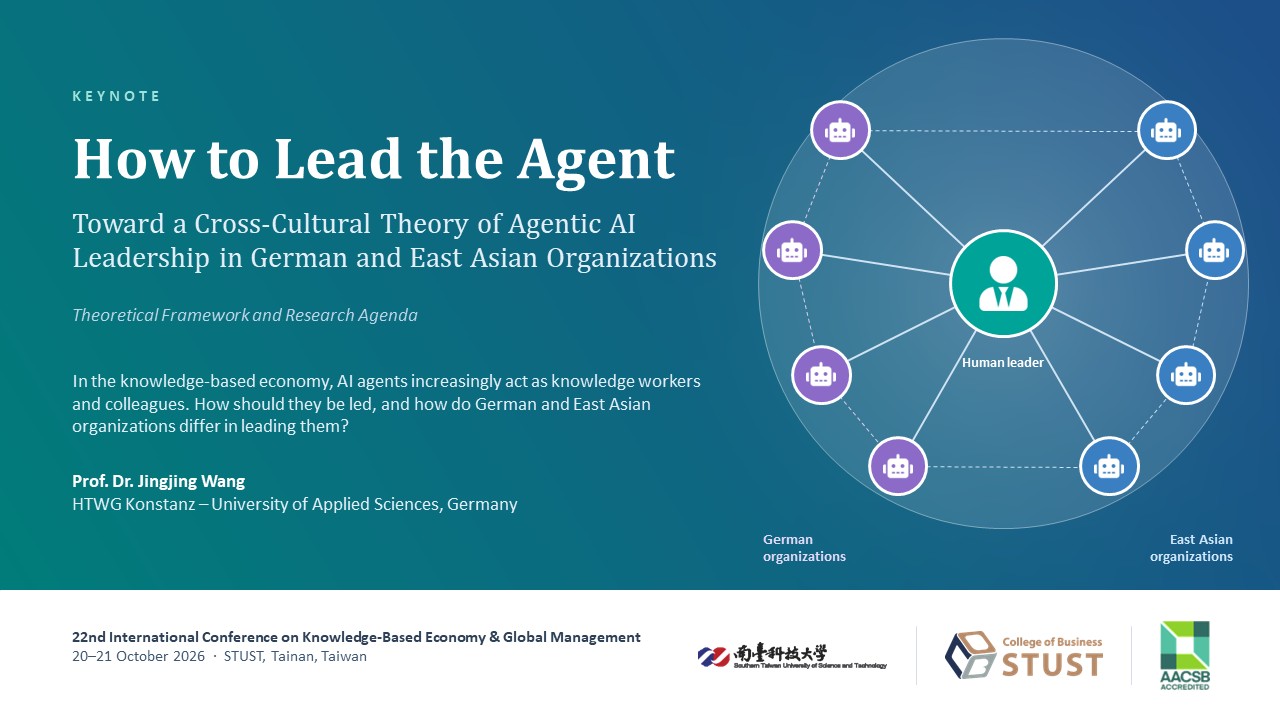
In October 2026 I gave a keynote at the 22nd International Conference on Knowledge-Based Economy & Global Management at STUST in Tainan, Taiwan. My question was simple: if AI agents now work like colleagues, how should human leaders lead them? And do German and East Asian organizations lead them differently?
Jensen Huang put it sharply at CES 2025: the IT department will become the HR department of AI agents. If agents are “hired” like staff, someone has to set their goals, delegate to them, check their work and correct them. That is a leadership task, not just an IT task.
Recent research supports this. In an NBER experiment, 249 leaders each led human teams and AI agent teams. Their success with agents predicted their impact on human teams (r = 0.81). Good leaders asked more questions and said “we” more often, with people and with agents alike (Weidmann, Xu & Deming, 2025). But fewer than 7% of participants were Asian, and culture was not measured. That is the gap my research addresses.
China and Germany: two ways of using AI
In short: Chinese tend to trust AI, use it widely and govern it as it goes. German tend to be cautious and set rules first, then adopt. The evidence comes from three sources: the University of Melbourne & KPMG global study (N > 48,000 in 47 countries), the Bitkom 2026 survey of 603 German companies, and a comparison of 104 AI policy documents by Tuzov & Lin (2024).
| Aspect | Chinese User | German User |
|---|---|---|
| Trust in AI (employees) | 68% (global average 46%) | 32% |
| Use of AI | 93% of employees use AI at work | 57% of companies use AI; only 11% use AI agents |
| Checking AI output | 78% rely on AI output without checking it (global 66%) | Second-lowest AI literacy of 47 countries; cautious adoption |
| Rules and “shadow AI” | 85% hide their AI use, although 69% report a company GenAI policy | Data protection (66%) and legal uncertainty (56%) are the main brakes for AI users |
| Governance logic | Utility-oriented: ethics as a tool for development; fast, binding, short-term rules | Rights-based: ethics as the purpose technology must serve; consultative, long-term rules |
Sources: Gillespie et al. (2025), University of Melbourne & KPMG, incl. the KPMG China country report; Bitkom (14 Sept 2026); Tuzov & Lin (2024), Telecommunications Policy, 48, 102850. Note that the China figures refer to employees and the German adoption figures to companies, so they show a pattern, not a one-to-one comparison.
Two caveats keep the picture honest. Shadow AI is not only Chinese: almost half of German respondents admit to breaking internal AI rules or passing off AI content as their own work (KPMG Germany, 2025). And Chinese AI policies actually contain more ethics language than German ones. The difference lies in what ethics is for, not whether it is there.
What this means for leaders
These differences are likely to shape how leaders treat AI agents day to day. In my keynote I put forward the Comparative Agentic Leadership Model (CALM) with seven dimensions. For example:
- Delegate tasks: Chinese leaders may hand more tasks and decisions to agents. German leaders may check agent output more often to avoid errors.
- Set governance: Chinese organizations may adopt first and govern as they go. German organizations may set rules before rollout.
- Develop powerful agents: Chinese leaders may give agents broader data access. German leaders may stick to data minimization.
- Redesign the organization: German firms may redesign work step by step with works councils. Chinese firms may restructure faster.
These are hypotheses, not findings yet. Both ends of each dimension are legitimate leadership logics, and neither is better. For leaders in multinational companies, the real value is understanding how colleagues in the other culture think, so that German–Chinese teams can lead AI agents together instead of past each other.
Where do you stand? Get your personal CALM profile
You read the cultural averages. Now find out your own leadership style. Take the CALM Study and get your personal AI leadership profile right after you finish.
Your profile places you on all seven CALM dimensions, each on a scale from 0 to 5. Are you values-anchored or results-focused? Do you verify before use or trust and delegate? Do you set rules before rollout or adopt first and govern as you go? You see where you stand right away, and you can use it to reflect on your leadership and discuss it with your team.
- Instant result: your personal CALM profile appears as soon as you submit.
- About 8 minutes, works on your phone.
- Anonymous and GDPR-compliant: no names, e-mail or IP addresses are stored.
- No AI agent experience needed: if you know what AI agents are, answer as you would act.
- Shape the research: your answers feed the first Germany–China comparison, and results will be shared with participants.
Who can take part: People who use AI, in Germany and/or in China,
👉 Take part now: jingjingwang.de/calm
Please also share the link with colleagues and partners, especially across German–Asian teams. The more leaders take part, the clearer the picture of how cultures lead AI.
Here is an example of the profile you will receive:

Prof. Dr. Jingjing Wang, HTWG Konstanz – CALM: Comparative Agentic Leadership Model