
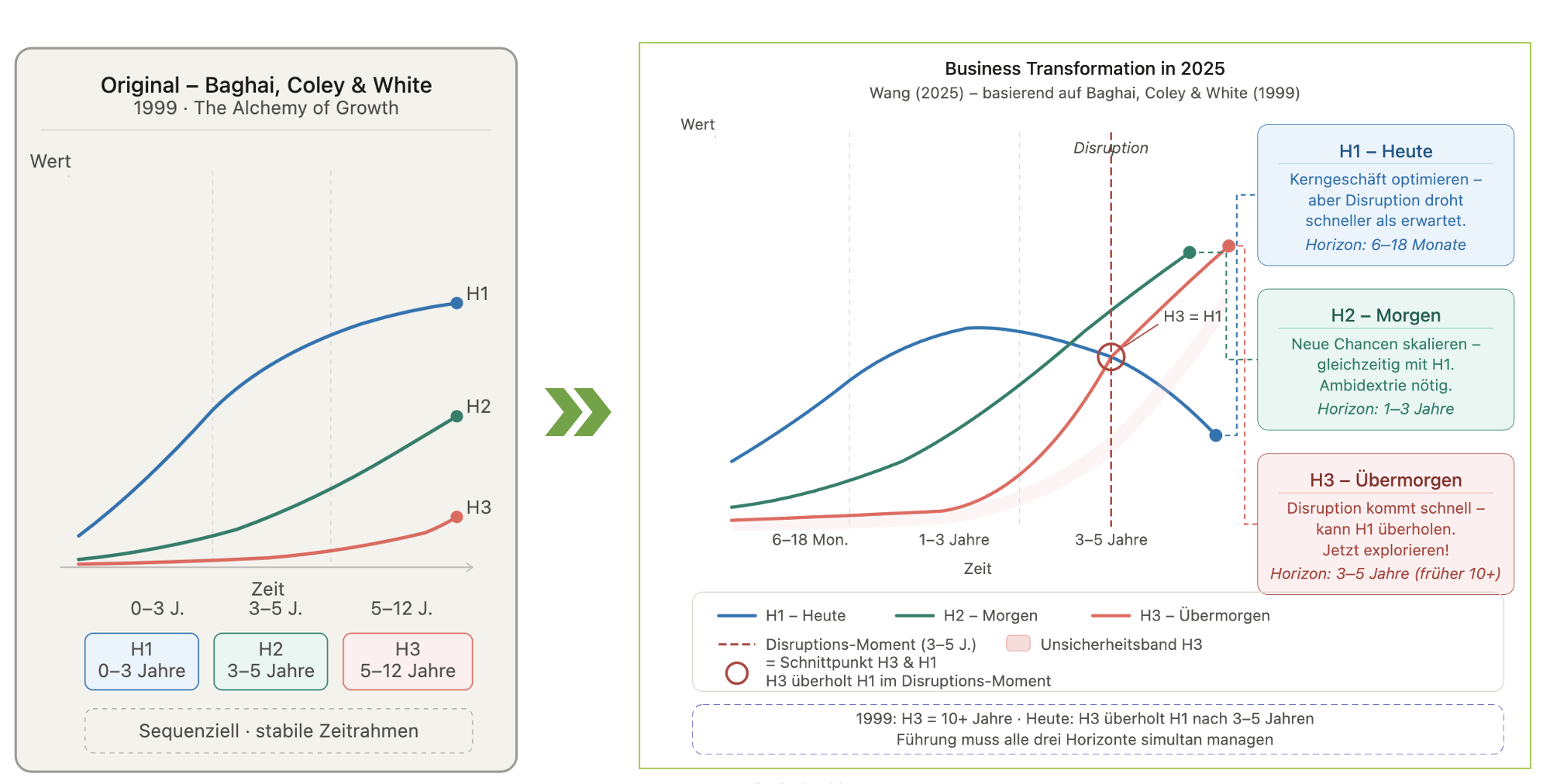
Central thesis: Prof. Dr. Jingjing Wang’s 2026 revision of the Three Horizons Model does not merely update a timeline — it dissolves the managerial luxury of sequential thinking. If H3 disruption now arrives within 3–5 years rather than 10+, then every leadership strategy premised on temporal separation is structurally obsolete, and ambidexterity transforms from a competitive advantage into an existential prerequisite.
A scholarly analysis based on Prof. Dr. Jingjing Wang (2026), HHL Leipzig Leadership Training Presentations and Handouts, building on Baghai, Coley & White (1999)
Imagine you are the captain of a great ocean liner. For decades, the company manual assured you that icebergs drift slowly — that your radar operators would spot danger a full day before impact, giving you ample time to adjust course, inform the crew, and reassemble strategy in calm waters. Now imagine discovering, mid-voyage, that the icebergs have begun to move at ten times the speed the manual predicted. The ship has not changed. The crew has not changed. But the window for response has shrunk from twenty-four hours to two. This, in essence, is the intellectual provocation at the heart of Prof. Dr. Jingjing Wang’s 2026 reformulation of the Three Horizons framework — and its implications for organizational theory are as dramatic as they are underexplored.
Strategic management has long relied on the Three Horizons Model, introduced by Mehrdad Baghai, Stephen Coley, and David White in their 1999 landmark work The Alchemy of Growth. The model’s elegance lay in its simplicity: great companies do not choose between sustaining today’s business and building tomorrow’s. They pursue all three simultaneously — optimizing the core (H1), scaling emerging businesses (H2), and seeding future options (H3) — but across a generous temporal spread. In 1999, H3 referred to innovations a decade or more in the future, giving leaders the comfort of managed sequentiality. Wang’s intervention, grounded in the empirical velocity of digital disruption, challenges precisely this comfort.
I. The Architecture of the Original Model
To appreciate the magnitude of Wang’s revision, one must first understand the structural assumptions embedded in the original framework. Baghai et al. conceived of the three horizons not as departments or budgets, but as mindsets requiring fundamentally different managerial logics. H1 demands efficiency, execution, and incremental optimization. H2 requires entrepreneurial investment and the management of emerging revenue streams. H3 calls for exploratory patience — a willingness to seed radical innovation without demanding short-term returns.
“The model’s original genius was its insistence on simultaneity. Its fatal assumption was that time would cooperate.”
The genius of the model was precisely its insistence on simultaneity. Yet the model’s temporal architecture contained a hidden assumption — that the horizons themselves were stable. That H1, H2, and H3 would remain neatly spaced across the timeline. This assumption held through much of the industrial era. By the 2020s, Wang argues, it had collapsed entirely.
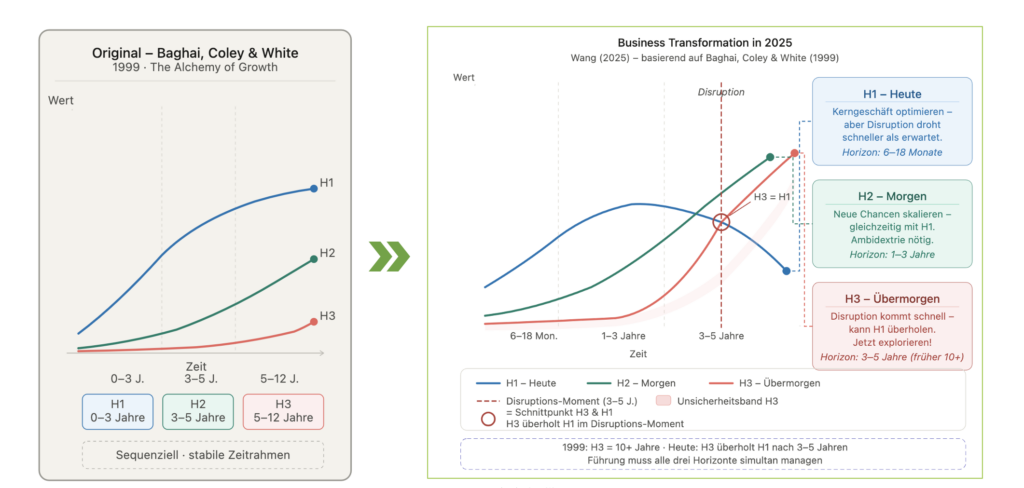
Figure 1. Left: The original Three Horizons Model (Baghai, Coley & White, 1999), featuring stable, sequential time frames (H1: 0–3 J., H2: 3–5 J., H3: 5–12 J.). Right: Prof. Dr. Jingjing Wang’s 2026 revision, in which the H3 disruption moment has accelerated to 3–5 years, intersecting and overtaking H1. The uncertainty band around H3 acknowledges the irreducible volatility of disruption velocity. Source: Prof. Dr. Jingjing Wang (2026), HHL Leipzig Leadership Training Presentations and Handouts, based on Baghai, Coley & White (1999).
As Figure 1 makes vivid, the left panel of Wang’s comparative visualization shows the original model’s generous, sequential spacing — H3 appearing as a remote, exploratory horizon safely distant from the urgency of H1. The right panel is structurally transformative: H3 does not merely approach H1 — it crosses it, overtaking the core business at the very moment of disruption. The labeled intersection point, “H3 = H1,” is not a stylistic flourish. It is the analytical core of Wang’s entire argument.
II. The Disruption Acceleration Thesis
When technology compresses time
Wang’s core empirical claim is precise and falsifiable: what once took over a decade to emerge as existential disruption now arrives within three to five years. She is not speaking of incremental change, but of the moment at which H3 — the exploratory, still-speculative future — overtakes H1 in value-generating capacity. In Wang’s model, that crossing falls within a single strategic planning cycle.
“1999: H3 = 10+ Jahre · Heute: H3 überholt H1 nach 3–5 Jahren. Führung muss alle drei Horizonte simultan managen.” — Prof. Dr. Jingjing Wang (2026), HHL Leipzig Leadership Training Presentations and Handouts.
The empirical evidence supporting this compression is substantial. The average lifespan of an S&P 500 company fell from over 60 years in the 1950s to under 20 years by the 2010s (Foster & Kaplan, 2001; Innosight, 2021). Technology adoption curves have dramatically steepened: it took telephone technology 75 years to reach 50 million users; the internet required 4 years; Pokémon GO achieved this in 19 days (Deloitte Insights, 2020). Generative AI tools crossed the 100 million user threshold in 60 days — faster than any technology in recorded history (Hu, 2023).
What makes Wang’s contribution analytically original, however, is not the disruption speed claim itself. It is the organizational consequence she draws: if H3 now lands inside the H1 planning window, then the traditional buffer that allowed sequential strategic adaptation has vanished. The horizon architecture, which was always intended as a portfolio management device, now demands simultaneous execution across all three modes — not as an aspiration, but as a baseline condition of organizational survival.
III. The Paradox at the Heart of Simultaneous Leadership
Ambidexterity as existential imperative
This is where Wang’s model generates its most generative — and most unsettling — theoretical tension. Organizational ambidexterity, the capacity to simultaneously exploit existing capabilities and explore new ones, has been extensively theorized since Duncan’s (1976) seminal work, and powerfully operationalized by Tushman and O’Reilly (1996) in their theory of the ambidextrous organization. The consensus in the literature is that ambidexterity is difficult, rare, and organizationally costly.
“Ambidexterity was once a competitive advantage. Wang’s model implies it has become the minimum viable condition for organizational existence.”
Wang’s temporal compression thesis implies something far more radical: ambidexterity is no longer a strategic option that excellent firms choose to pursue. It becomes the baseline requirement for any firm that wishes to remain relevant. A company that excels at H1 but neglects H3 — historically the dominant pattern among mature incumbents — no longer has the luxury of course correction.
This produces a genuine paradox. The cognitive and organizational demands of true ambidexterity are immense. Research consistently demonstrates that most leadership teams are structurally biased toward exploitation over exploration (March, 1991; Raisch & Birkinshaw, 2008). The very incentive structures that make H1 companies successful — performance metrics, accountability systems, resource allocation processes — systematically suppress H3 thinking. Wang’s model, read rigorously, suggests that the organizational structures most organizations have built to succeed are now the primary obstacle to their survival.
IV. The Uncertainty Band — Epistemological Humility in the Model
One of the most intellectually honest features of Wang’s visualization is the inclusion of an uncertainty band around the H3 trajectory (visible as the shaded region in Figure 1, right panel). This is not merely a graphical flourish. It represents a substantive epistemological claim: the acceleration of H3’s arrival is itself uncertain. The curve could cross H1 earlier or later than 3–5 years, depending on technological dynamics, regulatory environments, and market structures that remain inherently unpredictable.
This uncertainty band carries significant implications for strategic theory. It positions Wang’s model not as a deterministic forecast, but as a probabilistic frame for managerial attention. The appropriate response is not to plan precisely for a 4-year disruption horizon, but to develop organizational capabilities robust to a range of disruption velocities. This aligns with the strategic literature on dynamic capabilities (Teece, Pisano & Shuen, 1997) and resilience theory (Hamel & Välikangas, 2003), which emphasize adaptive capacity over precise prediction.
V. Narrative and Implications — The Leadership Imperative
A new cognitive demand on executives
Consider the CEO of a mid-size industrial company in 2015, reviewing a consultant’s Three Horizons presentation. H1 is running well. H2 pilots are underway. H3 — AI-driven manufacturing automation — is on the roadmap for the next decade. There is time. There is sequence. There is comfort in the architecture. Now situate that same executive in 2025. The H3 disruption is not on the horizon. It is at the door. The H3 curve has not merely moved closer; it has intersected H1 within the current strategic planning period.
Wang’s model thus reframes the central challenge of executive leadership not as a resource allocation problem, but as a cognitive and cultural one. The question is not which horizon receives what percentage of the R&D budget. The question is whether leadership teams are psychologically and organizationally structured to hold all three modes of being simultaneously — and whether governance structures, incentive systems, and board oversight have evolved to support this complexity.
VI. Critical Assessment and Open Questions
Wang’s reformulation is intellectually compelling, but several critical questions deserve attention. First, the model remains sector-agnostic. The 3–5 year disruption compression may be highly accurate for digital platform businesses, SaaS markets, and AI-adjacent sectors — but it is empirically unclear whether the same velocity applies to capital-intensive industries such as aerospace, pharmaceuticals, or infrastructure, where regulatory, safety, and physical constraints create inherent temporal buffers.
Second, the model’s normative implication — that firms must pursue all three horizons simultaneously — risks understating the role of strategic focus. Clayton Christensen’s disruptive innovation theory (1997) suggests that incumbents often fail not because they ignored disruption, but because they attempted to serve too many masters at once. The tension between Wang’s simultaneity imperative and Christensen’s focus discipline deserves richer theoretical elaboration.
Third, and perhaps most fundamentally: if the disruption window has compressed to 3–5 years, and if ambidexterity is structurally difficult for most large organizations, Wang’s model may be diagnosing a problem that most organizations are institutionally incapable of solving — at least in their current form. This suggests that the most profound implication of the model may not be for existing incumbents at all, but for the design of future organizations: governance architectures, incentive structures, and talent models built from the ground up for simultaneous multi-horizon operation.
Conclusion — Simultaneity as Survival
The Three Horizons model has always been, at its core, a theory of organizational time — of how firms distribute attention and resources across the present, the near future, and the distant future. Wang’s 2026 revision does not merely update the timeline. It collapses the architecture. When H3 arrives in 3–5 years, the sequential logic embedded in the original model becomes unavailable. The buffer dissolves.
What remains is a stark and clarifying thesis: in the current technological environment, the capacity for simultaneous multi-horizon leadership is no longer a mark of strategic excellence. It is the condition of strategic relevance. Organizations that cannot hold efficiency and exploration in parallel — that cannot optimize the core while genuinely investing in the disruptions that will supplant it — are not merely suboptimal. They are, in Wang’s compressed timeline, structurally vulnerable to obsolescence within a single planning cycle.
The deepest provocation of Wang’s model is not empirical but existential. It asks not only: how fast is disruption arriving? But: are the organizations we have built capable of surviving the answer? That question deserves to sit at the center of every boardroom, every business school curriculum, and every theory of strategic management that aspires to remain relevant to the world it seeks to explain.
References
Baghai, M., Coley, S., & White, D. (1999). The alchemy of growth: Practical insights for building the enduring enterprise. Perseus Books.
Christensen, C. M. (1997). The innovator’s dilemma: When new technologies cause great firms to fail. Harvard Business School Press.
Duncan, R. B. (1976). The ambidextrous organization: Designing dual structures for innovation. In R. H. Kilmann, L. R. Pondy & D. P. Slevin (Eds.), The management of organization design (Vol. 1, pp. 167–188). Elsevier.
Foster, R., & Kaplan, S. (2001). Creative destruction: Why companies that are built to last underperform the market. Currency/Doubleday.
Hamel, G., & Välikangas, L. (2003). The quest for resilience. Harvard Business Review, 81(9), 52–63.
Hu, K. (2023, February 2). ChatGPT sets record for fastest-growing user base. Reuters.
Innosight. (2021). 2021 corporate longevity forecast: Creative destruction is accelerating. Innosight Strategy & Innovation.
March, J. G. (1991). Exploration and exploitation in organizational learning. Organization Science, 2(1), 71–87.
Raisch, S., & Birkinshaw, J. (2008). Organizational ambidexterity: Antecedents, outcomes, and moderators. Journal of Management, 34(3), 375–409.
Teece, D. J., Pisano, G., & Shuen, A. (1997). Dynamic capabilities and strategic management. Strategic Management Journal, 18(7), 509–533.
Tushman, M. L., & O’Reilly, C. A. (1996). Ambidextrous organizations: Managing evolutionary and revolutionary change. California Management Review, 38(4), 8–29.
Wang, J. (2026). Business transformation in 2026: The three horizons model revisited. [Leadership training presentations and handouts]. HHL Leipzig Graduate School of Management. Based on Baghai, Coley & White (1999).
